

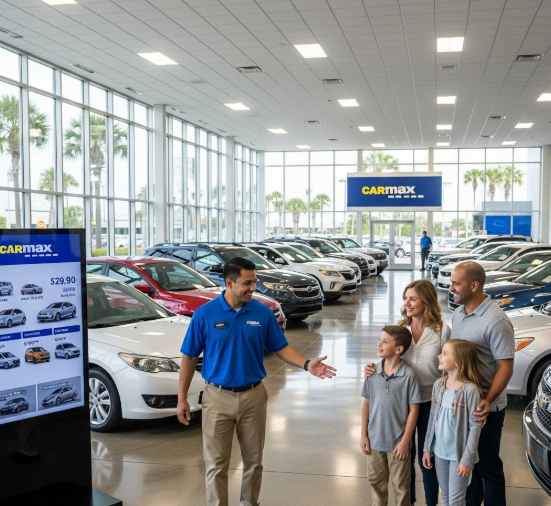
For millions of Americans, CarMax is the gold standard of the used car market. Their massive, gleaming stores, no-haggle pricing, and friendly blue-shirted associates have transformed a once-notorious industry. They’ve built a brand on being the “good guys,” a safe and transparent alternative to the traditional dealership experience.
But as a 13-year industry professional, I’m here to tell you that behind that friendly facade lies a different kind of machine—a sophisticated financial powerhouse that has more in common with a Wall Street bank than a typical car lot.
While not a “Buy Here Pay Here” in the traditional subprime sense, CarMax operates on the same fundamental principle: the car is the bait, but the real prize is the financing. With their own in-house finance company, CarMax Auto Finance (CAF), they have created the largest, most sophisticated, and publicly-traded version of a “Buy Here Pay Here” model in the world. Let’s break down the machine.

Based in Daytona Beach, Florida, Josh Logan provides data-driven analysis from the unique perspective of a seasoned automotive professional. His goal is to empower consumers with insider knowledge to navigate the complexities of the modern car market.
The “No-Haggle” Price and the Appraisal
CarMax’s core promise is a transparent, fixed price. This eliminates the biggest point of friction for consumers and builds immense trust. To support this model, which includes massive overhead for their state-of-the-art facilities and reconditioning standards, their retail prices are often set at a premium.
As we discussed in our “Trade-In” article, their appraisal offer is a powerful baseline for any consumer. It’s data-driven and quick. However, their business model requires them to acquire vehicles at a price that leaves significant room for reconditioning costs and, most importantly, profit. This is the first part of the machine: acquiring inventory at a controlled cost.
The Financing Engine (CarMax Auto Finance)
This is the heart of the CarMax machine and the core of our analysis. The company isn’t just a retailer; it’s one of the largest originators of used auto loans in the country. A look at their most recent quarterly financial report reveals a stunning picture.
CarMax Auto Finance (CAF) generated $141.7 million in income in a single quarter. Even more telling, the average interest rate charged to consumers across all its loans was 11.4%. While CAF financed a slightly lower percentage of cars this quarter (41.8% of units sold), it’s clear that the finance arm is a massive and critical profit center for the overall business. They are a bank that happens to sell the collateral for their own loans.

The Hidden Risk
The “Provision for Loan Losses”
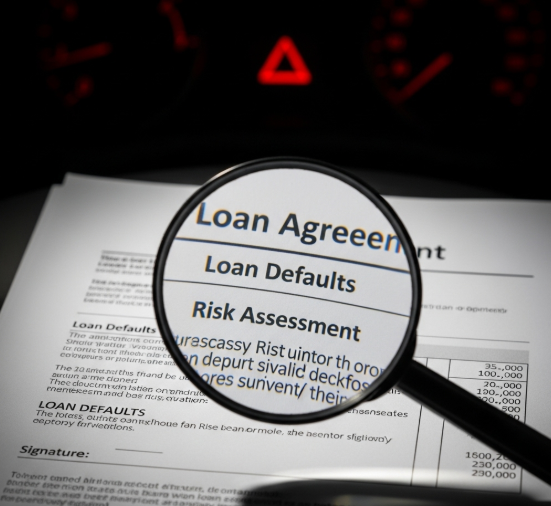
Here is the data point that truly reveals what’s happening under the surface. In their report, CarMax noted that their provision for loan losses increased significantly to $101.7 million for the quarter.
In simple terms, this means they are setting aside more money because they expect more of their customers to default on their loans in the future. They specifically cite “loss performance among 2022 and 2023 vintages and economic uncertainty” as the cause. This is a powerful, data-backed signal that the consumer is financially stressed, and CarMax’s own data is forecasting a tougher economic road ahead.
What This Means for the Broader Market
CarMax is so large that its business decisions and internal data act as a bellwether for the entire used car industry. The numbers in their financial reports are more than just a single company’s performance; they are a “canary in the coal mine” for the health of the American consumer and the used car market as a whole.
The most critical signal is their increased “provision for loan losses.” When a data-science-driven powerhouse like CarMax, with access to millions of data points on consumer payments, starts setting aside more money because it expects more defaults, it’s a clear warning that the financial health of the average car buyer is becoming fragile. They are forecasting tougher times ahead based on the performance of loans they issued over the last two years. This is a red flag that every dealer and lender in the country is watching closely.
Furthermore, their appraisal process effectively sets the price floor for the used car market. Their ability to make a data-driven, cash offer on nearly any car in minutes forces all other dealers to stay competitive, creating a baseline value that underpins the entire market.

A Holistic View
So, what is the final verdict on the CarMax machine?
The holistic view is that CarMax is a brilliant, publicly-traded finance company that has mastered the art of acquiring and moving the collateral—the cars—needed to generate its primary product: auto loans. It is a machine built for incredible efficiency, transparency, and profit.
As an industry professional, my advice to you, the consumer, is not to view them as “good” or “bad,” but to understand them as a powerful tool. Here is how you should use that tool to your advantage:
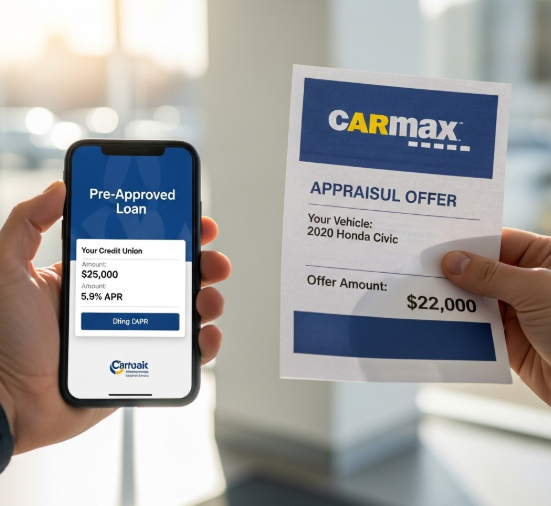
- Use Them for a Baseline Offer. Absolutely get their written appraisal on your trade-in. It is a powerful, data-backed number that is good for seven days, giving you a risk-free floor for your negotiations elsewhere.
- Always Compare Their Financing. The 11.4% average interest rate is a key data point. Always come prepared with a pre-approval from your own bank or a local credit union. This allows you to compare offers and ensure you are getting the most competitive loan possible.
- Understand the “Convenience Premium.” Their no-haggle price includes their reconditioning costs, overhead, and profit. You are paying a premium for a streamlined, low-stress experience. A private sale will almost always net you more money, and a traditional dealer may have more price flexibility if you are prepared to negotiate.
CarMax is a fantastic tool for convenience and establishing a baseline value. But understanding the machine behind the blue shirt is the key to ensuring you are the one who gets the most value out of the transaction.
A Finance Company That Sells Cars
When you connect the data, the picture becomes clear. CarMax has built a brilliant business, but it’s essential for consumers to understand what that business truly is. They are not just a used car retailer; they are a finance company that has perfected the art of acquiring and moving the cars needed to generate their primary product: auto loans with an average rate of over 11%.
Their own financial data reveals the risk in the system, with a growing number of loans expected to go bad. The use of separate LLCs is a standard corporate structure, but the profits—and the risks—are all part of the same machine.
So when you walk into CarMax, remember that you are entering a highly efficient system designed to provide a seamless experience that encompasses the car and, most importantly, the high-interest loan. Understanding this allows you to appreciate their model while still making the smartest possible financial decisions for yourself.

I appreciate you reading this, and encourage you to engage with me in the comments and on social media. You can get the latest automotive updates as soon as they are published by subscribing above. Thanks for the support, and until next time!





 TheLoganZone
Leave a comment