
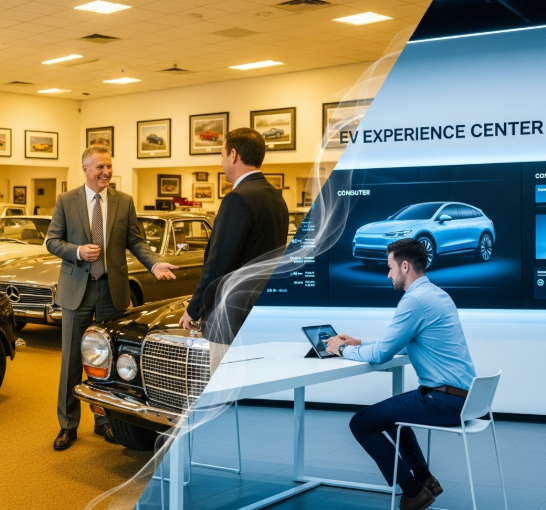
For over a century, the process of buying a new car in America has remained fundamentally unchanged: you go to a branded, independently-owned franchise dealership. It’s a model protected by a complex web of state laws and woven into the fabric of every local economy. But for the first time, a real challenger has emerged: the sleek, online, direct-to-consumer (DTC) model, championed by EV pioneers like Tesla, Rivian, and Lucid.
The debate is often framed as a simple choice between the old way and the new way. But the reality is far more complex. The future of car buying isn’t just about technology; it’s about a high-stakes battle for control, and the established players have a strategic pivot up their sleeves that almost no one is talking about.
The System: Understanding the Franchise Dealership Model
To understand the future, we have to understand the present. The current dealership model exists for specific legal and logistical reasons.
- The “Why”: State franchise laws were enacted decades ago, designed to protect small, local business owners from being crushed by the immense power of giant automakers. These laws prevent a company like Ford or GM from opening a company-owned store right next to a family-owned one and selling cars for less.
- The Pros: This system provides clear benefits. It creates a nationwide network of service centers essential for handling recalls and repairs, generates thousands of local jobs, and allows consumers to see and test drive vehicles in person.
- The Cons: For consumers, the friction comes from the business model itself. With price negotiation, dealer-added fees, and a reliance on profits from the financing and insurance (F&I) office, the experience can feel adversarial and opaque.
Source: Based on publicly available state franchise laws and analysis from the National Automobile Dealers Association (NADA).

The Challenger: The Rise of the Direct-to-Consumer (DTC) Model
EV startups, unburdened by a legacy network of dealers, saw an opportunity to rewrite the rules.
- The “What”: The DTC model uses the internet as the showroom. Pricing is fixed, negotiation is eliminated, and the entire transaction, from build-out to financing, is handled online. The physical locations are often “galleries” or “experience centers” rather than traditional dealerships.
- The Pros: The primary appeal is transparency and ease. The price is the price, and the process avoids the pressure of a commissioned sales environment.
- The Cons: The model faces immense legal hurdles in many states that ban or severely restrict direct sales. Furthermore, building a coast-to-coast service network without dealer partners is a slow, capital-intensive process, creating a significant challenge for owners needing repairs.

The Inevitable Pivot: The Dealer Groups’ Endgame
This is where the story gets interesting. The common theory is that if DTC were to win, legacy dealerships would simply vanish. This fundamentally misunderstands the nature of power and capital in the modern auto industry.
The players aren’t just small, family-owned stores anymore. They are massive, privately and publicly-traded conglomerates like AutoNation, Penske Automotive Group, and AMSI. These groups own hundreds of dealerships and wield billions of dollars in capital and political influence.
They would not disappear. They would pivot.
Here is the most likely scenario—a theory of how the established powers would not just survive a shift to DTC, but potentially thrive in a new way:
- The Great Sell-Off: If automakers like Ford or Toyota were legally cleared to sell directly, they would still need a massive physical footprint for deliveries, service, and test drives. The dealer groups would sell their prime real estate—their existing dealerships—to the automakers for a multi-billion dollar windfall, rebranding them as “Brand Experience & Service Centers.”
- The Capital Redeployment: Armed with billions in cash from the sale, these former dealer groups would transform into automotive-focused investment firms. They would use that capital to acquire massive blocks of stock in the very same publicly-traded auto companies.
- The New Power Structure: With a large enough ownership stake, these former dealer magnates could gain seats on the automakers’ boards of directors. From this new position, they could influence company policy from the inside, reaping the financial rewards of stock appreciation and dividends without the immense overhead, risk, and liability of operating the physical stores.
In this scenario, they would achieve the ultimate goal: all of the financial benefits of a thriving auto industry with none of the direct operational headaches. They wouldn’t be responsible for payroll, facility upkeep, or customer satisfaction issues—they would simply be powerful shareholders and board members.

A Battle for Control, Not Just Sales
The future of car buying will not be a simple victory for one model over the other. It will be a complex evolution shaped by immense financial and political pressure. The debate over DTC is not just about convenience; it’s about the fundamental structure of a trillion-dollar industry. The established players have too much capital and too much influence to simply fade away. They won’t just adapt; they have a clear path to reconsolidate their power in a new and even more streamlined form.

I appreciate you reading this, and encourage you to engage with me in the comments and on social media. You can get the latest automotive updates as soon as they are published by subscribing above. Thanks for the support, and until next time!




 TheLoganZone
Leave a comment