
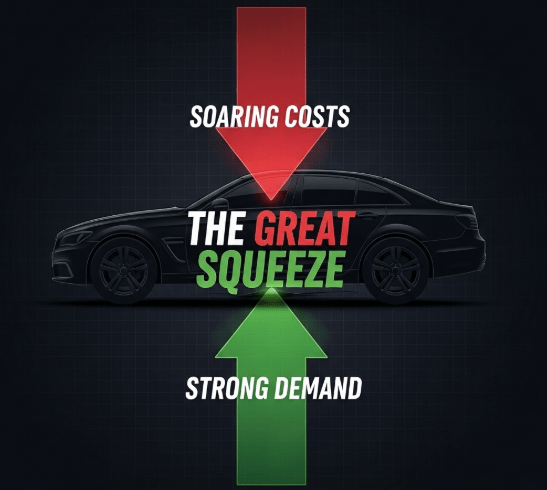
For the past month, the U.S. auto market has been sending completely contradictory signals. One report shows surging sales, the next shows collapsing profits. One data point suggests an inventory glut, the next screams of a supply shortage. Taken individually, these reports paint a confusing and chaotic picture. But when synthesized, they tell the single most important story of the 2025 auto market: a story of an industry caught in a brutal and unprecedented financial vise.
This is The Great Squeeze.
The market isn’t facing a simple inventory glut or a straightforward demand collapse. It’s facing something far more complex: a period of remarkably strong consumer demand running headfirst into a wall of exploding production and ownership costs. Automakers have the customers they need, but they are struggling to make a healthy profit from them. This deep dive connects all the key data points—inventory, sales, consumer inflation, and producer inflation—to reveal the true state of the industry.
Chapter 1
The Demand:
Unmistakable Signs of Strong Demand
Contrary to widespread economic anxiety, the American consumer is still buying cars at a startlingly resilient pace. The narrative of a collapsing market simply isn’t supported by the data.
First, the headline number from July showed a high sales volume, which was our initial clue. But the real evidence arrived this week in the inventory reports. In a stunning reversal, the new vehicle days’ supply plummeted from 80 to 73 days, while total inventory on the ground shrank by 150,000 units. This is the clearest possible signal that the retail sales pace is actively outstripping production and delivery. The “glut” is gone; a supply crunch is now a real risk.
This demand isn’t just for new cars. The used car market is also tightening, with the overall days’ supply dropping from 47 to a lean 43 days. This demand pressure is what caused the surprising +0.5% spike in used car prices in the July CPI report, snapping a four-month streak of declines. Across the board, from the new car showroom to the used car lot, the data shows a consumer base that is active and willing to buy.
Chapter 2
The Squeeze:
A Crushing Wall of Rising Costs
While automakers would normally celebrate such strong demand, their ability to profit from it is being systematically crushed by a multi-front assault of rising costs.
It begins at the factory. The July Producer Price Index (PPI) report was a bombshell, revealing a massive 1.0% spike in the cost of motor vehicle parts manufacturing in a single month. This “cost explosion,” as we reported, is a direct hit to the bottom line of every automaker, compounding the margin pressures from the geopolitical tariffs we analyzed in Q2. The cost to simply build a car is skyrocketing.
Simultaneously, the cost to own a car is also climbing, which puts a ceiling on how much consumers can afford to pay for the vehicle itself. The July CPI report showed the cost of motor vehicle insurance is up a staggering 5.3% year-over-year, while maintenance and repairs continue their relentless 6.5% annual climb. These are non-negotiable expenses that eat into a household’s total transportation budget, leaving less room for the car payment itself.

Chapter 3
The Synthesis:
Trapped in the Middle
This is the Great Squeeze in action: strong consumer demand is pulling from one side, while a wall of production and ownership costs is pushing from the other. Automakers are trapped in the middle.
In a normal market with high demand, they could simply raise prices. But with consumer budgets already strained by high insurance and repair costs, there is a limit to how much more the market can bear. In a market with high costs, they would normally cut back, but with strong demand and tightening inventory, they are pressured to keep producing to avoid losing market share.
This leaves them with only a few strategic moves, which will define the market for the foreseeable future:
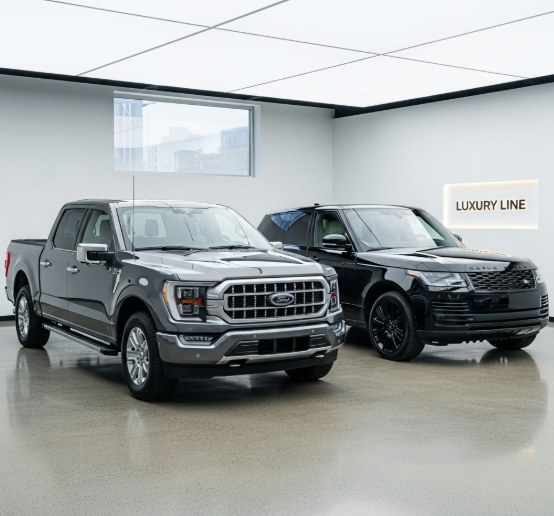
- They will abandon low-margin vehicles. The era of the affordable new sedan is definitively over. Automakers will be forced to double down on their most profitable vehicles: full-size trucks, luxury SUVs, and high-end EV models.
- They will pass costs to the consumer. The brief period of stabilizing new car prices is likely finished. Automakers will have no choice but to incrementally raise MSRPs to offset the spike in their own costs. The days of deep discounts and incentives are not coming back anytime soon.
- They will accelerate the push for post-sale revenue. This is the most critical takeaway. The “Car as a Subscription” model is no longer a futuristic experiment; it is an economic necessity. If automakers cannot make enough profit on the one-time sale of the vehicle, they will fight to earn it back every single month through software unlocks and app-based services.
Chapter 4
The Effects:
What to Watch For Next
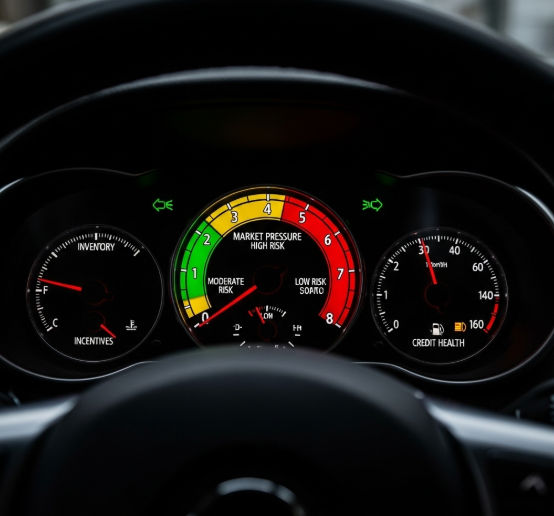
Understanding the Great Squeeze is only half the battle. As analysts, we must now turn our attention to the key data points that will signal where the market is headed next. The tension between strong demand and high costs is unsustainable, and one side will eventually have to give. Here are the four critical indicators I will be tracking daily and reporting on the moment they drop:
- Days’ Supply: This is now the single most important metric. Will the new vehicle supply continue to tighten below 73 days, forcing prices even higher? Or will automaker production finally catch up and cause inventory to swell again? The direction of this number will dictate the market’s tone.
- Incentive Spending: For months, automakers have enjoyed near-zero incentive spending. If consumer demand finally buckles under the pressure of high prices and ownership costs, the first sign will be the return of rebates and low-APR financing. This will signal a major shift in market power back toward the buyer.
- Consumer Credit Health: The pressure on the consumer is immense. We will be closely watching the next Consumer Credit reports for any uptick in auto loan delinquency rates. A rise in defaults is the ultimate red flag that the demand we’re seeing is built on a fragile financial foundation.
- The Next Inflation Reports (CPI & PPI): Was July’s cost explosion a one-time shock or the beginning of a new inflationary trend? The August CPI and PPI reports will be crucial. If we see another month of rising costs for parts and insurance, the squeeze will only intensify.
Chapter 5
The Holistic View:
What This Really Means
When you zoom out and connect all these data points—inventory, sales, consumer costs, and producer costs—a clear and sobering picture of the future emerges. The Great Squeeze isn’t just a temporary market condition; it’s an accelerator forcing a fundamental change in the entire automotive business model.
For the Consumer: The message is clear and immediate. The era of the “deal” is over for the foreseeable future. The primary challenge for any car buyer will be affordability. With firm new-car prices, a critically short supply of affordable used cars, and relentlessly rising ownership costs (insurance and repairs), the total cost of transportation will consume a larger portion of the average household budget. Making a financially sound decision is more difficult, and more important, than ever.
For the Industry: The Great Squeeze is an existential threat to the traditional business model. With profits on the initial sale being crushed, automakers are now completely dependent on two things for their survival:
- Selling their most expensive, highest-margin vehicles (trucks and luxury SUVs).
- Accelerating their push into post-sale, recurring revenue.
This is the ultimate takeaway. The “Car as a Subscription” model is no longer a futuristic experiment; it is the industry’s primary answer to the Great Squeeze. The pressure you see in this data is the reason automakers are so desperate to get a monthly fee for your heated seats and remote start. Their old way of making money is breaking, and this is their strategy to build a new one.

The auto market is now defined by this tension. It’s a high-stakes battle between the consumer’s strained wallet and the manufacturer’s squeezed balance sheet, and it will reshape our relationship with the automobile for the next decade.

I appreciate you reading this, and encourage you to engage with me in the comments and on social media. You can get the latest automotive updates as soon as they are published by subscribing above. Thanks for the support, and until next time!





 TheLoganZone
Leave a reply to BREAKING ANALYSIS: PPI Report Shocks with a Drop, But Key Auto Costs Tell a Different Story – TheLoganZone Cancel reply