
This Audio above is a Podcast style, AI Audio Overview of the Article you will be reading, it is not a line by line narration, but rather more content for you to enjoy!
In the world of automotive analysis, there are moments when the fog of speculation is instantly cleared by a single, authoritative voice. That moment happened yesterday. From our desk here in Daytona Beach, TheLoganZone dialed into the Cox Automotive Q3 market call, an industry event where the company’s top minds present their data and outlook. We came with a specific question, honed by months of reporting on the consumer affordability crisis: what is the ground truth regarding the volume of repossessions entering the wholesale market?
We directed our question to the panel, and the answer came directly from Jonathan Smoke, the Chief Economist of Cox Automotive. His response was a moment of stunning candor that provides the single clearest explanation for the distress we see in the auto loan market today.
Smoke confirmed that repossessions are indeed at a “record level.” But he didn’t stop there. In a detailed, on-the-record answer to TheLoganZone, he pinpointed the two specific, over-stressed consumer cohorts that are driving this record distress: buyers who purchased cars at inflated prices during the 2021-2022 bubble, and consumers now being crushed by the resumption of federal student loan payments.
This is not a market returning to normal. According to the industry’s most respected economist, this is a market buckling under the weight of two distinct, powerful, and predictable pressures.

Based in Daytona Beach, Florida, Josh Logan provides data-driven analysis from the unique perspective of a seasoned automotive professional. His goal is to empower consumers with insider knowledge to navigate the complexities of the modern car market.
Manheim Q3 Q&A
Automotive Strategist, Joshua Logan:
Hello, and thanks for taking my question.
My reporting has been heavily focused on the consumer affordability crisis, evidenced by recent distress in the subprime market and rising loan loss provisions from major retailers.
From Manheim’s unique position, could you provide some color on the trends you’re observing in the volume of repossession units entering the auction lanes?
And more importantly, what is your team’s outlook on how that specific flow of inventory will impact overall wholesale price stability in the fourth quarter?
Thanks Again for the reporting, data and insights you give.
Jonathan Smoke, Chief Economist of Cox Automotive:
“So Jeremy, I can jump in at first and you can certainly add color to give you a second to breathe. But, um, we we basically have been seeing a record level of repossessions. And if you just take that number and talk about the growth or just talk about the absolute numbers relative to the last several years and also relative to our last normal year in 2019, it really sounds like we’re going through a major crisis period. Um, but a lot of that growth is really in the total loan base. We’ve had an average lengthening of loans, um, and as a result, there there are, uh, there are record levels of of loans out there that are essentially would would have been leading us to higher default levels and higher ultimate repossession levels.
That said, we had have been seeing a relatively elevated default level, but I think the default trend has more or less stabilized this year because it was really going up from being below normal in 2023 and the couple of years prior to be to being normal and then above normal last year, and this year no longer growing. And when you double-tap into the data, you basically see that there are really two sources of stress. One is used vehicle loans that were originated at the peak of used vehicle values, so vintages from late 2020 and 2021 and early 2022 that have subsequently seen the most depreciation and effectively have much more negative equity in many cases. So the consumer just doesn’t have a lot of options if they do run into difficulty with their job or other financial pressure.
The second source of stress, which is one that we’ve shared some commentary on, especially last quarter, is student loans. And I actually think if you could isolate and eliminate people who have student loans and have fallen behind on student loans from the auto loan mix, and you were to eliminate used car loans made back in 2021 and 2022, we probably would have a very normal default level. And so, you know, just as Jeremy was describing with projecting what the Manheim index is going to be, understanding the moves that are happening in repossessions are also very complex and influenced by the differing trends in the different subcomponents. But we think we’re at a point of stabilization, and we’re really not expecting in the forecast we provided to see further deterioration in in the default and repo rate.”

Start Your Research Here
The ‘A’ in A.S.M.R. is for Automotive. This is your toolkit for becoming a smarter buyer.
The “Negative Equity Trap” from 2021-2022

The first source of stress, as Smoke explained, is a legacy issue born from the pandemic-era vehicle market. These are the loans that were written at the absolute peak of the pricing bubble.
“One is used vehicle loans that were originated at the peak of used vehicle values, so vintages from late 2020 and 2021 and early 2022,” Smoke noted. These loans, he explained, “…have subsequently seen the most depreciation and effectively have much more negative equity in many cases.”
This is what we call the “Negative Equity Trap,” and it’s a brutal financial vise. Imagine a consumer who needed a vehicle in 2021. Facing a historic inventory shortage, they paid a premium—perhaps $30,000 for a used vehicle that would have cost $22,000 just two years prior. They financed the entire amount. Today, that vehicle’s market value may have fallen to $18,000, but their loan balance is still a towering $25,000. They are $7,000 “underwater.”
As Smoke put it, “The consumer just doesn’t have a lot of options if they do run into difficulty with their job or other financial pressure.” They can’t sell the car, because the sale price wouldn’t even cover the loan. They can’t trade it in without rolling thousands of dollars of negative equity into a new, even more expensive loan. They are trapped. When another financial emergency strikes—a medical bill, a job loss—the car payment is often the first thing to go. This isn’t a case of irresponsibility; it’s a case of mathematical impossibility, and it’s a direct consequence of the pricing bubble.

Own It Right.
The ‘M’ is for Maintenance. Find your vehicle’s official factory service schedule.
The Student Loan Squeeze

The second source of stress is newer, but no less potent. It’s a financial shockwave that is just now beginning to ripple through the economy, hitting millions of households simultaneously. “The second source of stress… is student loans,” Smoke stated plainly.
For over three years, these payments were paused. That money was absorbed into household budgets, often going toward other necessities—including car payments. Now, that bill has come due, and it is creating a massive “payment shock” that is blowing up family budgets from the inside out. A monthly payment of $400 to $600 that was once manageable has now been compounded by another $300 to $500 payment that cannot be ignored.
The impact of student loans goes beyond just cash flow. It directly affects a consumer’s ability to manage their credit profile:
- The Credit Score Impact: The re-reporting of student loan balances and payments immediately impacts credit scores. For many, it will dramatically increase their Debt-to-Income (DTI) ratio, a key metric lenders use to determine creditworthiness. A higher DTI makes it much harder to qualify for new loans or refinance existing ones, closing off potential escape routes for consumers in distress.
- The Power of Wage Garnishment: Unlike almost any other form of consumer debt, federal student loans carry an extraordinary power. In the event of a default, the federal government can garnish up to 15% of a borrower’s disposable income without a court order. This is a guaranteed, automatic withdrawal from a paycheck, leaving even less money available for other critical obligations like a car loan.
This isn’t just another bill. It’s a structural change to the financial health of an entire generation of car buyers, and it’s happening at the exact same time the Negative Equity Trap is springing shut.

The Quote That Says It All
In his analysis, Jonathan Smoke delivered a single sentence that so perfectly isolates the problem that it deserves to stand on its own. It is perhaps the most clarifying statement made about the auto loan market this year. He said:
“…if you could isolate and eliminate people who have student loans… and you were to eliminate used car loans made back in 2021 and 2022, we probably would have a very normal default level.”
Read that again. This is a stunning admission from the chief economist of the industry’s central data hub. He is stating, unequivocally, that the current “record level” of repossessions and defaults is not a sign of a broad, systemic rot. Instead, it is being driven almost entirely by these two specific, distressed cohorts. The rest of the market, by implication, is performing normally. The crisis is not everywhere; it is concentrated with laser-like precision on the most vulnerable consumers.
An Unsustainable Squeeze, Confirmed
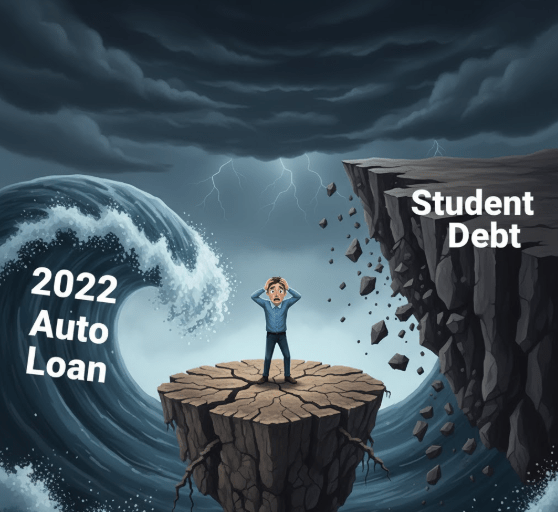
The American auto loan market is facing a perfect storm, a two-front war against both the past and the present. On one side, you have the legacy of bad loans written at the top of a historic pricing bubble. On the other, you have a new and powerful drain on household income that is stressing millions of families to the breaking point.
This insight, delivered directly from Jonathan Smoke to TheLoganZone during the Q3 market call, provides the ultimate confirmation of “The Great Squeeze“ we have been documenting for months.
The rise in repossessions is not a sign of a healthy market normalizing after a period of calm. It is a direct and painful symptom of a specific consumer base that has been squeezed from multiple directions and is now, predictably, breaking. This is the ground truth.

I appreciate you reading this, and encourage you to engage with me in the comments and on social media. You can get the latest automotive updates as soon as they are published by subscribing above. Thanks for the support, and until next time!





 TheLoganZone
Leave a reply to The Manheim Machine: An Exposé on the Company That Controls the Price of Every Used Car in America – TheLoganZone Cancel reply