
This Audio above is a Podcast style, AI Audio Overview of the Article you will be reading, it is not a line by line narration, but rather more content for you to enjoy!
This week, the titans of Detroit reported their third-quarter earnings, and in doing so, they revealed more than just their balance sheets. They revealed two starkly different strategies for managing the same, devastating crisis. This wasn’t a competition; it was a confession.
Here in Daytona Beach, we’ve been analyzing the reports from both General Motors and Ford, and the data is unequivocal. Both automotive giants are being gutted by massive, multi-billion-dollar tariff pressures. This is the “Great Squeeze“ on the manufacturer, playing out in real-time.
But while the pain was identical, the stories they told were not. Ford was forced to admit the truth, cutting its guidance by over a billion dollars and citing “tariffs” 37 times. GM, however, played a masterful game of corporate misdirection, using a $1.6 billion EV charge as a smokescreen to hide a much larger, $3.5 billion profit hole.
Both reports, when analyzed correctly, confirm the squeeze on the manufacturer is real. But it was Ford that provided the second, terrifying piece of data: the “smoking gun” that proves the consumer “Domino” is the next to fall.
In This Analysis:
- Chapter 1: The $1.6 Billion Smokescreen
- Chapter 2: The $3.5 Billion Hole (GM’s Real Story)
- Chapter 3: The Confirmation (Ford’s Story)
- Chapter 4: The Next Domino – The Consumer
- Chapter 5: Conclusion: The Market’s Dangerous Delusion
The $1.6 Billion Smokescreen
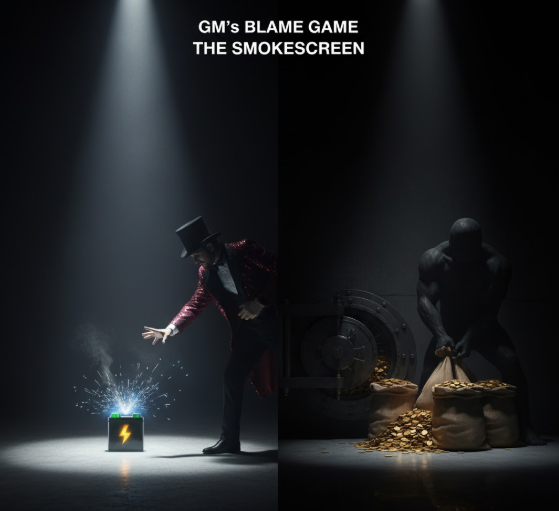
On Tuesday, General Motors’ earnings hit the wire, and the media immediately seized on the simple, clean narrative the company provided. Profits were down, and the “official” culprit was a massive $1.6 billion “EV Restructuring” charge.
Wall Street and the financial press bought this story hook, line, and sinker. It was a classic, brilliant piece of corporate misdirection. By pointing to a single, tangible “problem,” GM successfully created a blame game. It was a simple, easy-to-digest excuse that distracted from the far more complex and damaging reality. But as we’ve learned from a decade in “The Box,” the first story is rarely the real story.
Table 1: The “Blame Game” vs. The “Painful Truth”
| Company | General Motors (GM) | Ford (F) |
|---|---|---|
| Metric | “EV Restructuring” Charge | Key Driver of Guidance Cut |
| Data | $1.6 Billion | “Tariffs” (37 Mentions) |
| Narrative | GM’s “Official Story”: a smokescreen used to distract from the larger profit collapse. | The “Forced Confession”: Ford was forced to admit the $1B+ cut was due to external tariff pressures. |
Source: GM & Ford Q3 2025 Reports

Start Your Research Here
The ‘A’ in A.S.M.R. is for Automotive. This is your toolkit for becoming a smarter buyer.
The $3.5 Billion Hole (GM’s Real Story)
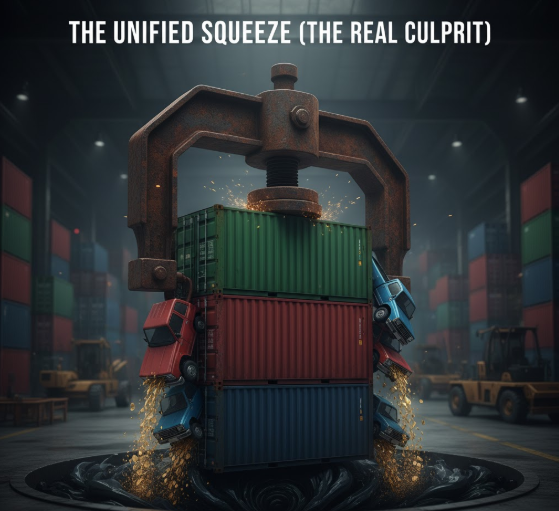
This is where we do the math that GM hoped no one would do. That $1.6 billion charge, while significant, does not come close to explaining the company’s massive year-to-date profit collapse.
Let’s look at the nine-month numbers. GM’s Net Income is down $2.96 billion compared to last year. Their EBIT-Adjusted is down $2.52 billion. This reveals a true profit hole that is much closer to $3.0 – $3.5 billion.
So where did that money really go? It aligns perfectly with the one number GM didn’t want to talk about: the $3.5 billion to $4.5 billion the company itself had previously estimated as the full-year hit from tariffs.
The EV charge wasn’t the story; it was the cover story. The real, hidden narrative was that the relentless, multi-billion-dollar tariff squeeze is bleeding the company dry, and GM chose to hide that fact behind a one-time EV write-down.
Table 2: The Real Story — The Tariff Squeeze
| Company | General Motors (GM) | Ford (F) |
|---|---|---|
| Metric | Estimated Profit Shortfall | Full-Year Adj. EBIT Guidance |
| Data | ~$3.0B – $3.5B | CUT by $1.0B+ |
| Narrative | The actual profit hole, which matches tariff cost estimates, not the $1.6B EV charge. | Ford’s guidance cut confirms the multi-billion-dollar scale of the tariff squeeze on the industry. |
Source: TheLoganZone Analysis / Q3 Reports

Own It Right.
The ‘M’ is for Maintenance. Find your vehicle’s official factory service schedule.
The Confirmation (Ford’s Story)

If GM’s report was a deception, Ford’s, just two days later, was a definitive and damning confirmation. Ford is being crushed by the exact same external forces, but their financial situation was such that they couldn’t hide it.
Ford was forced to admit the painful truth. They announced a massive $1.0 billion+ cut to their full-year profit guidance. And their leadership was stunningly, almost desperately, clear about the reason. The word “tariffs” was mentioned 37 times on their earnings call.
This is the key. Ford’s pained, reluctant honesty serves as the ultimate proof of the real squeeze. By being forced to admit the multi-billion-dollar scale of the tariff problem, Ford’s report inadvertently exposed GM’s $1.6 billion smokescreen as the deception it truly was.
The Next Domino
The Consumer
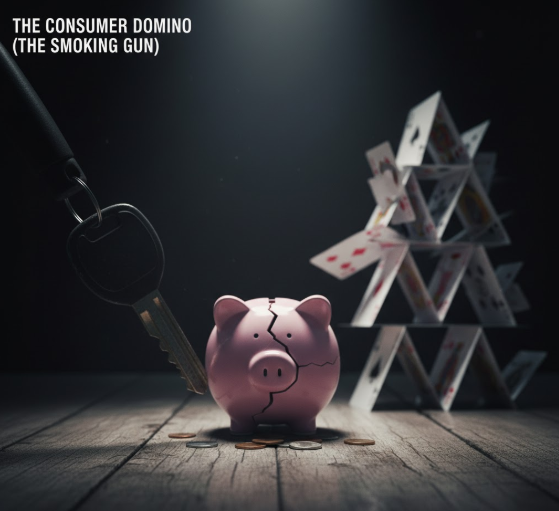
We have now established the reality of the “Great Squeeze” on the manufacturers. But this week’s data also exposed the next, far more frightening phase of this crisis: the collapse of the consumer.
The pressure has been building for months. We saw it in the September CPI report, which confirmed the cost of Motor Vehicle Maintenance & Repairs is still soaring, up 7.7% year-over-year. This is the background pressure that is suffocating the average American car owner.
But it was Ford’s report, once again, that provided the smoking gun.
Hidden deep in Ford Credit’s financials was the single most alarming number we have seen this year. The company’s Provision for Credit Losses—the money they are setting aside in expectation of their customers defaulting—exploded to $477 million.
This is the ultimate, data-driven confirmation of the “Domino Effect.” This is not a guess. This is one of the world’s largest auto lenders actively, financially bracing for a wave of its own customers to fail. The squeeze on the consumer is no longer a forecast; it is a present-day reality.
Table 3: The Consumer Domino — The Smoking Gun
| Source | U.S. CPI Report | Ford Credit (Q3) |
|---|---|---|
| Metric | Auto Maint. & Repairs | Provision for Credit Losses |
| Data | +7.7% (YoY) | $477 Million |
| Narrative | The background “squeeze” on every car owner. | The definitive proof. A major lender is actively bracing for its own customers to default. |
Source: U.S. BLS & Ford Credit Q3 2025 Report

The Market’s Dangerous Delusion

This week, the data provided a clear, sober, and alarming picture of the auto industry. Both major manufacturers are being gutted by a tariff war, and the consumer base they depend on is financially teetering on the edge of a cliff.
And how did Wall Street react to this grim reality? With irrational, dangerous euphoria.
GM stock popped over 15% after their report. Ford’s stock jumped over 12%. The market completely bought GM’s “blame game” and utterly ignored Ford’s transparent, dual warning of a profit collapse and a consumer default wave. The market is cheering for a fantasy. The real, data-driven story, visible to anyone willing to look past the headlines, is that the “Great Squeeze“ is tightening its grip on both the industry and the consumer. The data from this week did not just suggest this; it proved it.

Based in Daytona Beach, Florida, Josh Logan provides data-driven analysis from the unique perspective of a seasoned automotive professional. His goal is to empower consumers with insider knowledge to navigate the complexities of the modern car market.

I appreciate you reading this, and encourage you to engage with me in the comments and on social media. You can get the latest automotive updates as soon as they are published by subscribing above. Thanks for the support, and until next time!




 TheLoganZone
Leave a comment